
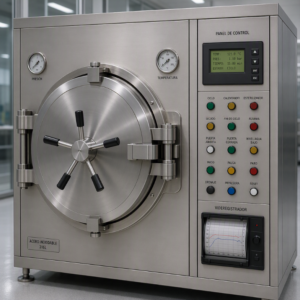
In the pharmaceutical and biotechnology industries, autoclaves play a critical role in sterilization and decontamination processes. Although the mechanical lifespan of these systems can extend over decades, their associated control systems typically become obsolete in significantly shorter timeframes.
Good Manufacturing Practices require computerized systems supporting critical processes to be controlled and to maintain their validated state throughout their entire lifecycle. In this context, the control system of an autoclave, including programmable logic controllers, human machine interfaces, supervisory control and data acquisition systems, and data acquisition and storage systems, must ensure not only proper process execution but also traceability, reliability, and data integrity.
European regulations, through EU GMP Annex 11 Computerised Systems, establish that systems must be maintained in a validated and up to date state, implicitly considering obsolescence management as part of lifecycle management. However, many facilities still operate control systems designed under outdated standards, creating increasing compliance risks. Additionally, the growing regulatory requirements regarding data integrity in recent years, as reflected for example in the draft revision of Annex 11, mean that historical workaround approaches applied to obsolete systems are no longer viable.
Furthermore, the need to improve energy efficiency, reduce operational risks, and adapt to new industrial cybersecurity and digitalisation requirements is constrained by the presence of legacy systems.
Technological obsolescence of control systems
Technological obsolescence is one of the main drivers behind the need to upgrade autoclave control systems. This situation typically manifests through:
Programmable logic controllers, human machine interfaces, and supervisory control systems that are no longer supported by the manufacturer, contrary to GAMP 5 recommendations emphasizing supported and widely used technologies
Operating systems that are obsolete and incompatible with current security and maintenance requirements defined in applicable regulations
Discontinued proprietary software without corrective or evolutionary maintenance
Inability to obtain critical spare parts, compromising system availability, business continuity, and the intended use principle
Network and communication architectures that are not aligned with current industrial cybersecurity requirements such as IEC 62443 and NIS2
High energy consumption and limitations in implementing monitoring and optimisation strategies
From a regulatory perspective, operating with unsupported components makes it difficult to demonstrate system control and continued compliance with intended use requirements, while also posing a serious business continuity risk.
Impact on data integrity
Data integrity is a fundamental pillar of GxP compliance. Both EU GMP Annex 11 and Title 21 Code of Federal Regulations Part 11 establish clear requirements regarding user identification, traceability, security, and audit trails.
In legacy autoclave control systems, common deficiencies include:
- Use of generic user accounts, violating the principle of individual attribution.
- Poorly defined user permissions allowing recipe or critical parameter changes without proper authorization.
- Absence of secure and protected electronic timestamps, undermining reliable electronic records principles.
- Incomplete or missing audit trails.
- Lack of historical data storage and backup and recovery mechanisms.
- Potential for undetected data manipulation, compromising record trustworthiness.
- Absence of recipe versioning and formal review and approval cycles, contrary to change control and configuration management principles defined in GAMP 5.
These limitations directly violate ALCOA plus principles, widely recognized by both EMA and FDA as a reference for data integrity.
Limitations compared with current operational practices
Beyond regulatory aspects, outdated control systems present significant operational limitations:
- Lack of complete electronic batch records, contradicting the electronic batch record approach promoted by current guidelines.
- Dependence on external recorders that capture only process variables and not contextual information such as alarms, events, or operator interventions.
- Inability to continuously capture and store data, hindering trend analysis, deviation investigations, and batch review.
- Unplanned production downtime due to lack of spare parts, directly affecting business continuity and supply.
- Limitations in integrating systems into modern digital architectures such as manufacturing execution systems, historians, energy analytics, remote monitoring, or industrial internet of things platforms.
- Absence of proper network segmentation and security mechanisms aligned with current operational technology cybersecurity standards.
These issues increase operational risk and reduce responsiveness to deviations while also hindering manufacturing digitalisation efforts.
Autoclave replacement versus control system upgrade
Complete replacement of an autoclave may be considered a definitive solution, but it presents significant drawbacks:
- Complex civil works modifications, especially in classified areas.
- Extended production downtime affecting planning and capacity.
- High investment costs and significant qualification effort including installation qualification, operational qualification, and performance qualification of the new equipment.
As an alternative, upgrading the control system allows regulatory and technological risks to be addressed while retaining the existing mechanical equipment with significantly lower investment.
Control system upgrade as a regulatory and technical solution
Modernisation of the control system through the implementation of a new architecture based on supported platforms enables:
- Compliance with EU GMP Annex 11 and Title 21 Code of Federal Regulations Part 11 requirements regarding security, audit trail, and user management.
- Application of GAMP 5 principles using standard solutions and scaling validation effort based on risk.
- Implementation of robust data integrity controls aligned with ALCOA plus principles.
- Facilitation of process data integration into digital manufacturing systems such as electronic batch record systems and manufacturing execution systems.
- Improved operational and energy efficiency through advanced monitoring and control strategies.
- Adaptation of system architecture to current industrial cybersecurity and network segmentation requirements.
- Reduction of business continuity risks associated with obsolete hardware and software.
From a validation and qualification perspective:
- Full validation of the new computerized system including software and hardware is required.
- Full qualification of the autoclave equipment is not required since no mechanical or functional modifications are introduced.
- Repetition of sterilization cycles is required to confirm that the controlled process maintains its validated behaviour, although this is aligned with periodic requalification programmes.
Conclusions
Obsolescence of autoclave control systems represents a significant risk in GxP environments, directly impacting data integrity, regulatory compliance, and operational continuity. Current regulatory guidelines, including EU GMP Annex 11, Title 21 Code of Federal Regulations Part 11, and GAMP 5, explicitly require lifecycle management of computerized systems, including obsolescence.
Control system upgrades are positioned as a technically and regulatorily sound solution, enabling extension of equipment life, reduction of operational and continuity risks, improved cybersecurity, and facilitation of integration into digital manufacturing and energy efficiency strategies, without the high costs and complexity associated with full autoclave replacement.
Regulatory references
- EU Guidelines for Good Manufacturing Practice, Annex 11 Computerised Systems, European Medicines Agency.
- FDA 21 Code of Federal Regulations Part 11 Electronic Records and Electronic Signatures, Food and Drug Administration.
- ISPE GAMP 5 A Risk Based Approach to Compliant GxP Computerized Systems.
- MHRA and EMA Data Integrity Guidance and Definitions.
- PIC S Good Practices for Data Management and Integrity in Regulated GMP and GDP Environments.
- NIS2 Network and Information System Directive 2.